
Starting a home remodel project is exciting, until you realize you have no idea how to find someone you can trust with your home. How To Hire the Ideal Contractor gives you the exact roadmap to finding, interviewing, and hiring the best professional for the job, while protecting yourself every step of the way.
I have created The Contractor Hiring Worksheet To help speed up the process as you work through this guide. Print it out so you can fill in the blanks as you follow along.
Click the link below to get your copy now!
Get Your FREE Copy Now of The Contractor Hiring Worksheet by Clicking The Button Below
Where To Begin The Contractor Search
This step will give you a broad list of several contractors or remodeling companies that are specialists in your project’s type of work. As you go through this section, begin making a list of everyone you like the best. At the end, your goal is to have about 3-5 top candidates to move forward with.
Ask Friends For Recommendations

Think about friends or family members that have had work done on their home. Ask if they would recommend the company that did the work. What specifically did they like about them? What didn’t they like? Is there anything they would change about the experience?
If you can’t think of anyone you know, reach out to local real estate brokers for advice. Oftentimes a good realtor will have the contact info of a person or organization they prefer, and are happy to pass the info on to you.
Search Social Media

Social media is a great resource for finding practically anyone these days. There are some facebook groups that help with the search for local contractors. They let you see what other homeowners say about them too. There are many more groups than these, but some of them are called:
- Homeowners looking for Contractors and Remodelers
- Contractors & Home Improvement Referrals
- Home Renovation and Restoration Support Group
- Home Improvement Services Needed
There may be different groups around your location. Continue this part of the search further as needed.
Check Online Reviews
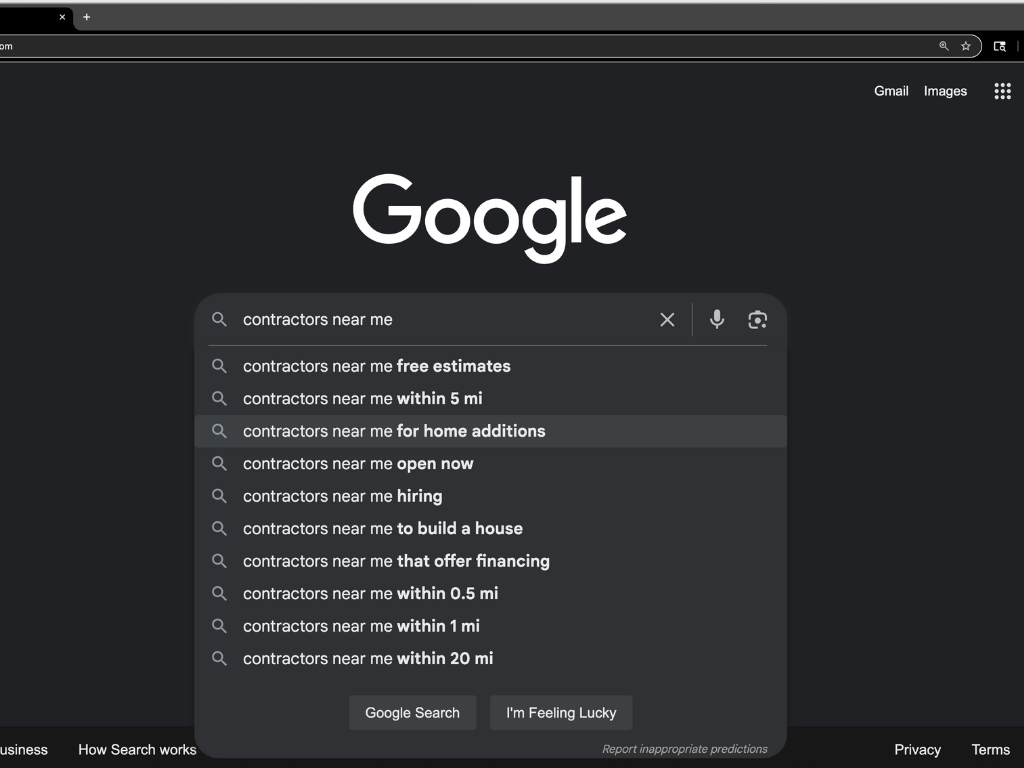
A web search can help you find companies nearby that do this type of work. Do a search for “Contractors Near Me” or “Contractors in (Your Area)”. You will get a list of local professionals with their reviews.
Start narrowing them down by looking at the ones who have a lot of reviews and a high star rating. Start with ones that have over 50 reviews AND above 4 stars. The higher the value for both these metrics, the better.
Use Online Directories

There are several online directories that archive contractors who specialize in this type of work. Take a look at some of them below:
- Yelp
- Angie’s List
- HomeAdvisor
- Houzz
- Better Business Bureau (BBB)
Local Building Associations
Contact your local Home Builders’ Association or Remodeling Contractors’ Association. You will need to reach out to them, but they may have a list of people you can consider.
The search for the right contractor can be a bit of a process. It’s good to think outside the box as you are searching because there may be other areas to look at that are not included in this list. Networking can be a valuable tool during this process as well. Be meticulous because you will only choose one, and you want them to be the best!
Interviewing Candidates
⚠️ Contractor Red Flags ⚠️
Look for these when you interview
- No written contract
- No references
- Pressures for large payment upfront
- Avoids answering questions
- No proof of insurance
- Shows up late or misses appointments
Have your Contractor Hiring Worksheet handy to take notes during this process. This will help you make your decision in the end.
Interviews are an important part of this process. It’s best if you can meet them face-to-face, but it isn’t necessary in the first meeting. You should meet them at least once before signing the contract.
Pay attention to HOW they answer the question. A good contractor will give you a heart-felt reply because they are confident in what they do. Look for possible changes in body language or voice. Some signs like avoiding eye contact, fidgeting, or closing their posture by folding the arms can be signs of discomfort or lying.
Does this person seem like they are somebody you want to open up your house to? Oftentimes our instincts tell us something important about the person we are talking to. Pay close attention to what your heart is telling you about the person sitting across from you.
Contractor Interview Questions

Previous Experience
What made you want to get into this business initially?
Their answer here should show you where their passion lies. If someone loves what they do they will express it in this answer. Do you get the feeling the person you are talking to is looking forward to working on your home?
How long have you been in the construction business?
There is a chance they answered this question in the previous one. You want to know what amount of experience they have with your type of project. The answer to this question should be a minimum of 5-10 years in this general field of work. If you want to dig deeper on your project requirements, now can be a good time.
Do you have any examples of remodeling projects like mine you’ve already done?
Their portfolio wont have exact replicas of what you want in your bathroom, but parts of it might be represented. This can be a good place for ideas to flow for you to use. You can discover portions of their portfolio pictures you like and want to include in your design. Don’t be afraid to change your mind about some of your previous ideas if you like something they show you.
Licensing and Insurance
Are you and your subcontractors licensed and insured? Can you provide your license number?
You want to make sure they are licensed in order to protect yourself. It’s good to have their license number in your paperwork in the off chance something goes wrong.
Do you offer any warranties? What do they cover?
They don’t always need to be warranted. There is a chance your local or state regulations require them. Do a quick search to find out more.
How do you handle post-project issues/repairs?
This should be included in the contract. We will cover this in more detail in the next section called Writing The Contract.
References
Can you provide at least 3 references for your work?
These can be previous clients, other contractors they worked with, etc. They don’t need to be the same job as what your project is. You want to call them and ask how the experience was. Get a feel for what the contractor’s work ethic is like, and if the projects were on time. If someone has been doing this work for a while they should have a few references.
Timeline/Project Management
Will you provide a detailed project timeline with milestones?
This is meant to be a basic timeline for the project. Milestones are a good way to keep the project on track. We will talk about how to work them into the contract as a payment plan below.
There may be some surprises that push the time frame back. You want to know how long the contractor thinks the project will take. Find out how they will handle any unexpected issues or delays in the project. Keep the timeline in your paperwork as well.
Communication
What is your preferred method of communication?
It’s ideal to have more than one method. Something like emails for non-pressing issues and text/phone calls for something quick or urgent is nice.
How often do you provide project updates?
This is a good time to find out if the updates will be in person or another method. It’s good to have regular updates just to make sure everything is on schedule. This line of communication can give you assurance the project is on track. There may be progress being made that you can’t see when you check in.
How do you handle changes to the project scope that may affect the budget?
There are multiple reasons for changes to occur. You may change your mind along the way about something once you see it in person. This is normal but can cost more money. The contractor may make a suggestion for something to take into consideration. It’s best to get large changes in writing with a signature.
Payment
What is your payment schedule?
A typical payment schedule can be something like: an initial deposit of 10-20% up front. Progress payments of 20-30% as the project hits milestones both parties agree on. Final payment of 10-15% is paid upon completion of the project. This should be included in the contract.
Cleanup
Will you be cleaning up and disposing of the debris?
It’s good for your contractor to dispose of any debris on a regular basis. Some mess is normal during this type of work, but you don’t want to be living in excessive debris, etc for long periods of time. This will become problematic for you and your family. A good contractor will take precautions and be mindful of keeping your house dust and debris free as much as possible.
Are you willing to agree to a payment holdback until the project is completed to my satisfaction?
Ideally you won’t be using this option. It’s nice to have security by including this if possible. I also have some examples of this below.
Writing The Contract

Disclaimer:
The contract examples and templates included in this ebook are provided for general informational purposes only and DO NOT constitute legal advice. They are not intended to replace consultation with a qualified legal professional.
Laws and regulations may vary by location and change over time. You should always consult with a licensed attorney before using or adapting any contract for your specific situation.
By using any of the sample content in this ebook, you agree that the author is not liable for any losses, claims, or damages that may result from its use. Use of this material is entirely at your own risk.
Each section is written in a way that you can include the specifics of your project by filling in the (underlined and parentheses) sections.
Once you’ve chosen the right contractor, make sure all aspects of the project including the payment schedule, timeline, and other specific details are outlined in a written contract. The contract is meant for both parties to have a clear understanding of what is to be expected during the duration of the project, and after.
Construction contracts may vary depending on state laws, the size and scope of your project, as well as other factors. Using a contract when hiring someone is a helpful tool that will enforce your protection in the event of something going wrong.
Some contractors choose not to work with one. This is a red flag! When technically “trust and a handshake” is a legally binding contract, it’s not the best way to conduct business of this type. Below is a list of the most common aspects in a contract, of which you can choose to use or not segments you like.
Clarity of Scope
This defines the scope of work you are taking on. It’s meant to be a detailed explanation of everything that will be done in the job. It helps prevent misunderstandings about what will be completed, materials being used, and the timeline for completion.
The Contractor agrees to perform the remodeling work described in Detailed Scope of Work, which includes but is not limited to:
- Demolition of (existing kitchen cabinetry and countertops)
- Installation of (new custom cabinetry and quartz countertops)
- (Electrical) upgrades in [kitchen area (up to 6 new outlets and 3 pendant light fixtures)]
- (Plumbing) adjustments [for sink relocation (within 3 feet of original location)]
- Installation of [new tile backsplash (up to 30 sq. ft.)]
Final cleanup and removal of construction debris
Exclusions
The following items are not included in the Scope of Work unless otherwise stated in writing:
- Structural modifications or engineering work
- Asbestos or hazardous material testing/removal
- Permits, fees, or inspections unless specified
- Painting or finishing outside of defined rooms
- Repairs to existing conditions not visible at the time of estimate (e.g., hidden water damage, mold, termite activity)
Change Orders
Any work requested by the Homeowner that falls outside the scope defined in this contract will require a written Change Order. Change Orders must be agreed upon in writing and signed by both the Contractor and the Homeowner prior to the commencement of the additional work. Each Change Order will specify:
- A detailed description of the additional work
- Any additional costs associated with the work
- The impact (if any) on the project timeline
Owner Responsibilities
The Homeowner agrees to:
- Provide timely access to the property during normal working hours
- Make all product selections (fixtures, finishes, etc.) within the timeframes agreed upon in the project schedule
- Remove or secure personal property from the work area to prevent damage
Cost and Payment Terms
It is important to have a clear understanding of the cost of the project, payment schedule, and any penalties or incentives for meeting or missing deadlines. This will help avoid any disputes about payment. The payment guidelines should be agreed upon before work begins, and have the specifics included in the contract.
Option A: The contractor receives ⅓ of the payment up front, and another ⅓ is at the project’s agreed upon midpoint. The third payment is upon completion of the job. This is a good option for a small job that may only take a few days, and doesn’t have an extensive scope of work.
Option B: Make payments when milestones are met along the way. Divide up the project with the contractor, indicating what percentage of the payment is to be made as these milestones are reached. This is a great option for larger jobs that will take longer and have an extensive scope of work.
Total Contract Price
The total cost for completion of the work described in this agreement is ($75,000.00), subject to additions or deductions via approved Change Orders. This price includes labor, materials, subcontractor fees, and standard disposal of construction waste, as outlined in the Scope of Work section.
Payment Schedule by Milestone
Payments shall be made in accordance with the following milestones, subject to verification of completed work by the Homeowner:
Milestone | Description of Work | Payment Due |
Milestone 1 | Contract signing and project mobilization | [$7,500 (10%)] |
Milestone 2 | Completion of demolition phase | [$15,000 (20%)] |
Milestone 3 | (Rough-in of electrical and plumbing systems) | [$11,250 (15%)] |
Milestone 4 | (Completion of drywall, painting, and cabinet installation) | [$18,750 (25%)] |
Milestone 5 | (Installation of countertops, backsplash, and flooring) | [$11,250 (15%)] |
Milestone 6 | Final walk-through and punch list completion | [$11,250 (15%)] |
Change Orders and Additional Costs
Any changes to the original Scope of Work must be authorized in writing through a Change Order, which may affect the total project cost and schedule. Change Orders will include a breakdown of any additional charges and will be billed separately or incorporated into the next milestone payment, as mutually agreed.
Payment Terms
Payment for each milestone is due within (5 business days) of milestone completion and presentation of invoice. Late payments are subject to a finance charge of [1.5% per month (18% annually)] on outstanding balances.
Final Payment
Final payment is due upon satisfactory completion of the punch list and submission of the final invoice. No retainage will be withheld unless otherwise specified in writing. The Contractor will provide all lien releases and warranty documentation upon receipt of final payment.
Method of Payment
Payments may be made by check, direct bank transfer, or other method as agreed in writing. All payments should be made payable to:
[Contractor’s Legal Business Name]
Insurance and Liability
Verify that the worker has insurance coverage. Some types of insurance to look for are liability and workers’ compensation. This will protect you and the worker in the case of an accident or damages.
Contractor’s Insurance
The Contractor shall maintain, throughout the duration of the project, the following insurance coverages with reputable carriers licensed in the state where the work is being performed:
- General Liability Insurance with a minimum limit of ($1,000,000) per occurrence and ($2,000,000) aggregate, covering bodily injury, personal injury, and property damage.
- Workers’ Compensation Insurance as required by state law for all employees and subcontractors.
- Automobile Liability Insurance for any vehicles used in the execution of this contract.
Certificates of insurance shall be provided to the Homeowner upon request prior to the commencement of work and shall list the Homeowner as a certificate holder.
Homeowner’s Insurance
The Homeowner is responsible for maintaining adequate homeowner’s insurance, including coverage for fire, theft, flood, and other casualty losses. The Homeowner should notify their insurance carrier of the remodel project prior to the start of work.
Damage to Property
The Contractor will take reasonable precautions to protect the property during the course of the work. Any damage caused to the Homeowner’s property as a direct result of the Contractor’s negligence shall be promptly repaired or replaced at the Contractor’s expense.
Limitation of Liability
The Contractor shall not be liable for:
- Pre-existing structural issues, code violations, or hazardous conditions (e.g., mold, asbestos, lead paint) not disclosed or observable at the time of contract execution.
- Delays or damages caused by events outside the Contractor’s control, including but not limited to acts of God, extreme weather, utility outages, or material shortages.
Indemnification
The Contractor agrees to indemnify and hold harmless the Homeowner from any and all claims, damages, losses, and expenses, including attorney’s fees, arising out of or resulting from performance of the work, provided that such claim is caused by the negligence, recklessness, or willful misconduct of the Contractor or its subcontractors.
Permits and Regulations
It’s important to know who is responsible for getting any permits for the project. If this is something you are capable of, then put that in the contract. Failure to pull needed permits might create complications or fines.
Permits are required for certain aspects of a remodel project. Below is a list of common areas that might require a permit. This is a general description, and you should check with your local regulations and building codes for more clarity.
Structural Changes
Alterations to the structure of a building can be permitted. This includes changing wall locations or adding walls, changes to doors and window openings, or modifying roof structures.
Additions or Expansions
Adding new rooms, expanding your home’s size, or building new structures on your home.
Electrical work
It’s important that the electrical work on your house is done safely. That’s why electrical work is an area that typically requires permitting.
Plumbing work
Like electrical work, plumbing work can have a huge effect on your home when done incorrectly. Proper precautions should be taken to avoid any potential damage caused by plumbing mistakes.
Heating, Ventilation, and Air Conditioning (HVAC) Changes
Installing new or modifications to existing HVAC may require permits. This type of work requires cutting holes through walls, among other things. You want to be sure it is done in a safe way.
Roofing
Major roofing projects and altering the physical structure of the roof usually requires a permit. The roof is an integral part of the house that should not be altered negatively.
Window and Door Replacements
Sometimes a permit is required for the replacement of windows or doors. This is typically when the size or location of the opening is changed.
Demolition
Demolishing part of a structure can require a permit. You will want to make sure you are not removing a load bearing wall or other integral part of your home.
Check with your local building department or permitting office to find what your project’s specific permit requirements are. Permits ensure the work is done in a safe manner and in compliance with the local building codes.
If you fail to get the right permits it may cause fines, delays, and complications for selling the property.
Permit Responsibility
Unless otherwise specified in writing, the Contractor shall be responsible for obtaining all required building permits, inspections, and approvals necessary to perform the work described in this agreement. Permit fees are [included/excluded] in the total contract price.
Code Compliance
All work performed under this contract shall comply with applicable federal, state, and local building codes, ordinances, and regulations. In the event that code-required changes arise during construction that were not identified during the planning or estimating phase, such changes shall be handled through a written Change Order, including any associated cost or schedule adjustments.
Access for Inspections
The Homeowner agrees to provide the Contractor and relevant municipal officials access to the property as required to perform inspections and comply with permit conditions. The Contractor shall coordinate all required inspections and schedule them in a timely manner to avoid unnecessary delays.
Unforeseen Regulatory Issues
If unforeseen regulatory requirements, zoning issues, or inspection-related conditions arise that materially affect the Scope of Work or construction timeline, the Contractor shall notify the Homeowner in writing. Resolution of such issues may require a Change Order, design modification, or revised project timeline.
Licensure
The Contractor represents and warrants that they are properly licensed and authorized to perform remodeling services in the jurisdiction where the project is located. Copies of licenses and certifications shall be provided to the Homeowner upon request.
Timeline and penalty
You want a clear statement of what the project timeline is. Include the start and completion dates. State the provisions for any penalties or bonuses tied to the on time completion.
Project Start and Completion Dates
The project shall commence on or about [Start Date], subject to permit approval and material availability, and is estimated to be substantially completed by [Estimated Completion Date]. These dates are based on current projections and may be adjusted by mutual agreement in writing.
Construction Schedule
The Contractor shall provide a project schedule prior to the start of work, outlining key phases and milestones. The Contractor agrees to perform the work diligently and in a workmanlike manner to meet the estimated completion timeline, barring any delays outside the Contractor’s control.
Excusable Delays
The Contractor shall not be held liable for delays caused by:
- Weather conditions that make work unsafe or infeasible
- Material shortages or backorders beyond the Contractor’s control
- Delays in permit issuance or required inspections
- Changes in the Scope of Work initiated by the Homeowner
- “Force majeure” events, such as natural disasters, labor strikes, or public emergencies
In such cases, the Contractor shall notify the Homeowner promptly and provide an updated timeline.
Penalty for Unexcused Delays
If the Contractor fails to complete the project within [X] calendar days of the estimated completion date, and such delay is not excused in the Excusable Delays section above, the Contractor shall credit the Homeowner $[Daily Penalty Amount] per calendar day as liquidated damages, not as a penalty, for each unexcused day of delay beyond the grace period of [Y] days.
Bonus for Early Completion (Optional)
If the project is completed and passes final inspection more than [Z] days ahead of schedule, the Homeowner agrees to pay the Contractor a bonus of $[Daily Bonus Amount] per day, up to a maximum of $[Maximum Bonus Amount].
Substantial Completion and Final Completion
“Substantial Completion” shall mean the point at which the project is sufficiently complete, in accordance with the contract documents, to be occupied or used for its intended purpose, notwithstanding minor punch list items. Final Completion shall occur upon resolution of all punch list items and final payment.
Warranties and Guarantees
Clarify any warranty or guarantees on the materials and workmanship. This will help address possible issues that come up after the project is finished.
Contractor’s Warranty
The Contractor warrants that all labor and workmanship provided under this Agreement shall be free from defects for a period of [one (1) year] from the date of final completion. During this warranty period, the Contractor agrees to repair or replace, at no additional cost to the Homeowner, any work found to be defective due to improper installation, materials, or workmanship, provided the defect is not the result of misuse, neglect, or alteration by the Homeowner or others.
Manufacturer Warranties
All materials, appliances, fixtures, and equipment installed as part of this project shall be covered by their respective manufacturer warranties. The Contractor will provide the Homeowner with copies of all applicable warranties at the time of project completion and will assist in filing any warranty claims during the Contractor’s warranty period.
Warranty Exclusions
This warranty does not cover:
- Damage resulting from normal wear and tear, weather exposure, or acts of God (e.g., flooding, earthquakes, storms)
- Damage caused by misuse, abuse, lack of maintenance, or improper repairs by the Homeowner or third parties
- Pre-existing conditions or defects in the structure not caused by the Contractor’s work
- Hairline cracks in drywall, tile grout, or concrete that occur as a result of natural settling
Notice and Remedy Process
To initiate a warranty claim, the Homeowner must provide written notice to the Contractor within the warranty period AND within (30) days of discovering the issue. The Contractor shall have a reasonable opportunity to inspect the claimed defect and, if warranted, make the necessary repair within (15) business days of notice, unless otherwise agreed.
No Implied Warranties
Except as expressly provided above, the Contractor makes no other warranties, express or implied, including but not limited to warranties of merchantability or fitness for a particular purpose.
Extended Warranty (Optional)
If specified in writing and paid for separately, the Contractor may offer an extended warranty period for certain components of the project (e.g., roofing, windows, structural framing). Terms of any extended warranties shall be outlined in a separate addendum to this Agreement.
Dispute Resolution
There should be a clause that outlines what the plan is for a dispute to be resolved. This can be through legal action, arbitration, or mediation.
Good Faith Negotiation
In the event of any dispute, claim, or controversy arising out of or relating to this agreement, the parties agree to first attempt to resolve the matter through good faith negotiation. Both parties shall meet (in person, by phone, or virtually) within (10 business days) of written notice of the dispute to discuss possible resolution before pursuing formal proceedings.
Mediation
If the dispute cannot be resolved through negotiation, the parties agree to submit the matter to non-binding mediation before a neutral third-party mediator. Mediation shall take place in [County/City, State] and shall be conducted in accordance with the rules of the [American Arbitration Association (AAA) or other specified body], unless the parties mutually agree to a different process. The cost of mediation shall be split equally between the parties.
Binding Arbitration (Optional)
If mediation fails to resolve the dispute, and unless prohibited by law, the matter shall be resolved by binding arbitration, conducted in accordance with the rules of the [AAA or another agreed-upon arbitration service]. Judgment on the arbitrator’s award may be entered in any court having jurisdiction. Each party shall be responsible for their own legal fees and costs, unless otherwise determined by the arbitrator.
Small Claims Court Exception
Notwithstanding the above, either party may pursue a claim in small claims court if the amount in dispute is within the court’s jurisdictional limit, provided that the claim is not joined with other claims or parties and does not seek equitable relief.
Continued Work During Dispute
Unless otherwise directed by the Homeowner, the Contractor agrees to continue performing work under this Agreement during the dispute resolution process, to the extent reasonably possible and so long as payments are not being wrongfully withheld.
Attorneys’ Fees and Costs
In any legal proceeding arising out of this Agreement, the prevailing party shall be entitled to recover reasonable attorneys’ fees, court costs, and other expenses incurred in connection with the dispute, unless otherwise determined in mediation or arbitration.
Termination Clause
This is where you clearly state what the conditions are that can cause either party to terminate the contract. These could include but are not limited to a breach of contract, insufficient performance, or fraud.
Termination by Homeowner for Convenience
The Homeowner may terminate this Agreement at any time for any reason by providing written notice to the Contractor. Upon such termination, the Homeowner shall pay the Contractor for:
- All work completed up to the date of termination
- Any non-cancellable material or subcontractor commitments
- A reasonable termination fee of (10%) of the remaining contract value to cover administrative and demobilization costs
Termination by Homeowner for Cause
The Homeowner may terminate this Agreement for cause if the Contractor:
- Fails to perform work in accordance with the Scope of Work
- Fails to correct defective work within a reasonable time after written notice
- Becomes insolvent, declares bankruptcy, or ceases operations
- Violates material terms of this Agreement
In such cases, the Homeowner shall provide written notice and a (7-day) opportunity to cure. If the issue is not resolved, the agreement may be terminated with no obligation to pay for unperformed work. The Homeowner shall still be responsible for payment for all satisfactorily completed work and materials delivered to date.
Termination by Contractor
The Contractor may terminate this Agreement if the Homeowner:
- Fails to make payments as agreed within (10 business days) of receiving a written demand for payment
- Repeatedly interferes with or delays progress of the work
- Breaches any material term of the Agreement
The Contractor must provide written notice and a (7-day) opportunity to cure. If unresolved, the Contractor may stop work and terminate the Agreement. In such a case, the Homeowner shall pay the Contractor for all work completed, costs incurred, and a termination fee of (10%) of the remaining balance.
Effects of Termination
Upon termination by either party:
- The Contractor shall immediately cease work and remove all tools, equipment, and unused materials
- The Homeowner shall be entitled to possession of all work performed and materials paid for
- Any outstanding payments shall be settled within (15 business days) of the termination date
Survival of Terms
All provisions of this Agreement that by their nature should survive termination (e.g., indemnity, warranties, dispute resolution, payment obligations) shall remain in effect following termination.
Signatures
The most important part of the contract are the signatures. Without them the contract is worthless. Make sure to have a designated location for these signatures to be included. Signing the contract by both parties will take place after you and the contractor both agree to its terms.
Conclusion
Hiring the right contractor can make all the difference in your home remodel experience. What you just did is turned a potentially stressful interaction into a successful, even enjoyable one. By taking the time to plan ahead, ask the right questions, verify credentials, and get everything in writing, you’re setting yourself up for a smooth project and a finished space you’ll love for years to come.
Remember, a remodel isn’t just a financial investment — it’s an emotional one too. Trust your instincts, do your homework, and don’t be afraid to walk away from a contractor who doesn’t feel like the right fit.
Thank you for taking the time to read this guide. I hope it has helped you feel more confident and prepared as you go on your home remodeling journey. Here’s to finding the ideal contractor, and building your own personal sanctuary.
You Got This,
Kevin

Kevin
I grew up in a family where my dad and several uncles were general contractors. They took me to their jobsites to put me to work. They taught me so much about home upkeep as well.
I remember spending several summers in high school helping my father build houses. It gave me so much knowledge that I am excited to share with you!